
- Nuevo
- Libro
Digital
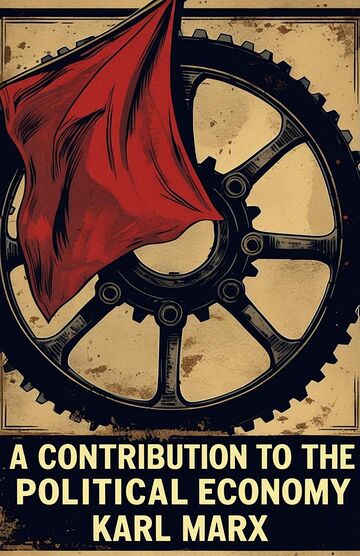
A Contribution to the Critique of Political Economy
A Contribution to the Critique of Political Economy (originally published in 1859) is one of Karl Marx's most important economic works and a foundational text in Marxist theory. This book laid the groundwork for Marx's magnum opus, Das Kapital, offering deep insights into the structural mechanisms of capitalism and the dynamics of economic systems grounded in class relations, value, and exchange. In this rigorous critique of classical political economy, Marx begins with a systematic analysis of commodities, exchange, and money—the elemental forms of capitalist production. He explores the transformation of use-value into exchange-value, the origins and functions of money, and the contradictions inherent in the circulation of commodities. Through his historical materialist method, Marx connects economic categories with specific historical stages of development, arguing that economic structures evolve through class struggles and social conflict. Included in this edition are the Author's Preface, where Marx outlines his dialectical materialist view of history, and "Introduction to the Critique of Political Economy," which elaborates on the relation between the base (economic structure) and superstructure (institutions, law, ideology) in society—a framework that would become central to Marxist philosophy. This work is essential for readers seeking to understand the genesis of Marxs critique of capitalism, and remains a cornerstone for students of economics, political science, philosophy, and critical theory. It is both a deep theoretical investigation and a revolutionary call to rethink the fundamentals of economic life.
-
Isbn9789372305494
-
Peso2.1 MB
-
Número de páginas321
-
IdiomaInglés
-
FormatoEPUB
-
ProtecciónDRM
-
ReferenciaBKW211375
Karl Marx
Nació en 1818 en Tréveris. Estudió en contacto con la izquierda hegeliana y en 1843 emigró a París. De esos años son Contribución a la crítica de la filosofía del derecho de Hegel y Sobre la cuestión judía, y el comienzo de su perdurable colaboración con Engels: tras madurar el materialismo histórico, publicaron el Manifiesto durante las revoluciones de 1848. Exiliado en Londres, inició los estudios que sistematizó en El capital e impulsó la reunificación del movimiento obrero europeo. Reseñó la Comuna de París de 1871 –La Guerra Civil en Francia– y, hasta su muerte en 1883, enfrentó a la socialdemocracia –Crítica al Programa de Gotha–, y contactó a los primeros revolucionarios rusos.